
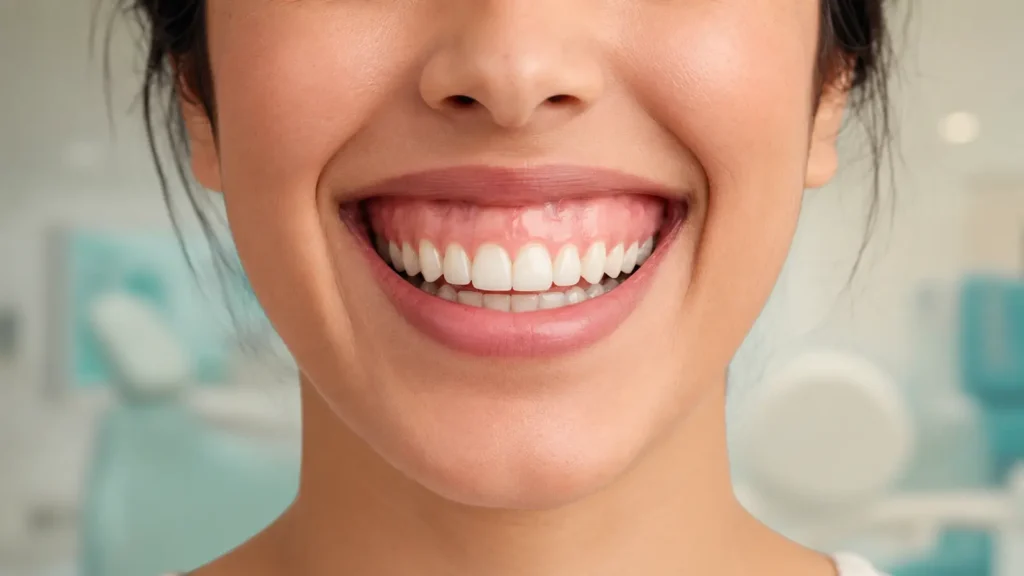
A gummy smile describes noticeable upper-gum display during smiling and is not itself a disease. Treatment succeeds when it addresses the cause. Removing gum alone is not suitable for every patient and may be unstable if bone position or lip movement is the main factor.
What is the condition?
Excessive gingival display results from the relationship between tooth length, gum, upper lip and jaw. Teeth may look short even when their full anatomical crowns are simply covered by tissue.
Symptoms and signs
- A broad band of gum shows during smiling
- Front teeth appear short or square
- An uneven gumline
- Concern about smile balance
Causes and risk factors
- Altered passive eruption with gum covering part of the crown
- Thick or enlarged gingival tissue
- A hypermobile or short upper lip
- Vertical maxillary excess
- Shortened teeth from wear or shape variation
- More than one contributing factor
When should you see a periodontist?
Assessment is advisable before any gum removal, particularly when teeth appear very short or the lip elevates markedly. Diagnosis prevents excessive tissue removal and protects healthy periodontal dimensions.
How is it diagnosed?
Smile analysis is performed at rest and in movement. Tooth proportions, gum and bone levels, and the tissue attachment are assessed. Photography, radiographs and digital scanning may support planning.
Treatment options
- Gingivectomy or gum contouring when excess soft tissue is the only issue
- Aesthetic crown lengthening with bone recontouring when bone is too close to the margin
- Orthodontic or restorative treatment for tooth-position or tooth-length problems
- Lip-movement treatment in selected cases with the appropriate clinician
- Orthognathic surgery for significant skeletal causes after multidisciplinary assessment
Recovery and expected outcomes
Mild swelling and sensitivity can follow contouring. The initial change appears quickly, but the gum continues to mature for weeks or months. Healing after bone recontouring takes longer, and final restorations may be delayed until the margin is stable.
Prevention and daily care
- An anatomical gummy smile cannot be prevented at home
- Control gingival inflammation before aesthetic treatment
- Use digital or trial planning where useful
- Follow aftercare and maintenance to preserve the gumline
Related articles
- Conditions we treat
- Dark Gum Pigmentation: Causes and Laser Gum Depigmentation in Dubai
- Gum Recession: Causes, Root Coverage and Gum Grafting in Dubai
Frequently asked questions
Is a gummy smile a disease?
No. It is usually an aesthetic feature, although inflammation can exaggerate swelling and should be treated.
Is gum cutting alone enough?
Only when soft-tissue and bone measurements confirm it is appropriate.
Is the result permanent?
Results can be stable after correct diagnosis; relapse is more likely when tissue is treated without addressing the cause.
When can I judge the final appearance?
Improvement is immediate, but final tissue maturation can take weeks to months.
Medical notice: This information is educational and does not replace a clinical examination. Treatment, recovery and outcomes vary with the diagnosis and the patient’s health.